
Combat Types Explained: Astral, Infernal & Primal
Rise in Time's new effectiveness system boils down to one loop — Astral beats Infernal beats Primal beats Astral — plus a neutral Umbral type. Here is how to use it.
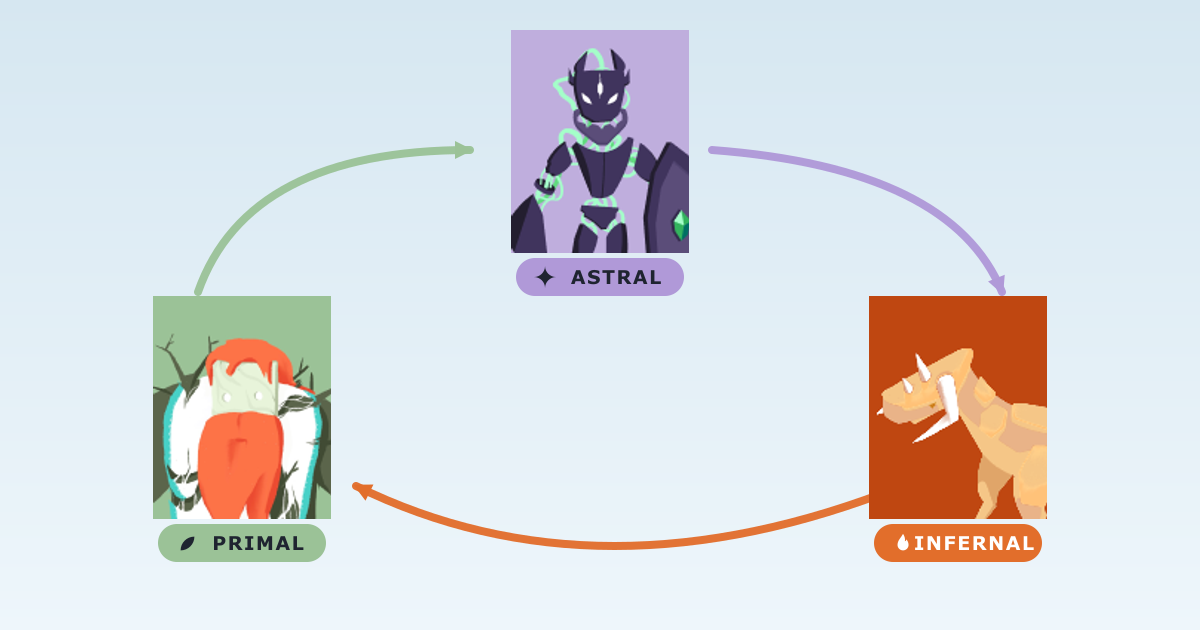
Rise in Time just replaced its old unit-by-unit effectiveness chart with something far easier to hold in your head: three combat types that beat each other in a loop, plus one neutral type. Learn the loop once and you can read almost any matchup on the map.
The counter cycle: Astral › Infernal › Primal
Every unit now belongs to one of four combat types. Three of them form a simple rock-paper-scissors cycle:
- Astral beats Infernal
- Infernal beats Primal
- Primal beats Astral
That is the entire ruleset. When your units go up against the type they counter, they fight at a bonus — and the same is true in reverse when you get caught by your counter. No long tables to memorize, just one loop.
Umbral: the unaligned type
The fourth type, Umbral, sits outside the cycle. Umbral units are effective against nothing — and, just as importantly, weak against nothing.
That makes them a dependable backbone. They never earn the counter bonus, but they can never be hard-countered either, so they hold up in any matchup. When you are not sure what you will face, Umbral is the safe pick.
How the bonus actually works
Effectiveness is not all-or-nothing. The bonus scales with how much of the enemy force your units counter. Bring a handful of the right type and you get a small edge; commit an army that counters most of what you are facing and the advantage is huge.
And because Rise in Time resolves battles deterministically, there is no luck involved. The same armies in the same matchup always produce the same result — the type advantage is a lever you control, not a dice roll.
How to play around types
- Check the type panel. Every unit’s detail view shows its combat type, plus who it is effective against and weak against.
- Scout, then counter. If you can see what an opponent is fielding, bring the type that beats it.
- Mix your army. A single-type force is easy to hard-counter. Blending types keeps you from being shut down by one clever answer.
- Lean on Umbral when uncertain. For blind attacks or defense against an unknown force, unaligned units won’t leave you exposed.
Why we changed it
The old system spelled out effectiveness unit by unit — powerful, but a lot to memorize. The new combat types keep all of that deterministic depth while collapsing it into a single, teachable idea: one cycle of three, plus a neutral. New players can grasp it in seconds; veterans still get to outplan their opponents.
Want to see the matchups for yourself? Browse every unit’s type on the Orb wiki, then put the cycle to work — play Rise in Time.